Why Incident Reporting Systems Fail During Real Emergencies
Most organizations have incident reporting systems in place.
Employees are trained to document issues, submit reports, and escalate concerns through formal channels.
That process matters. Documentation helps organizations track problems, improve policies, and support compliance.
But during a real emergency, reporting alone is not enough.
When someone is facing a threat, medical issue, aggressive behavior, or urgent workplace safety concern, the first priority is not paperwork.
The first priority is response.
The Problem: Reporting Is Not the Same as Responding
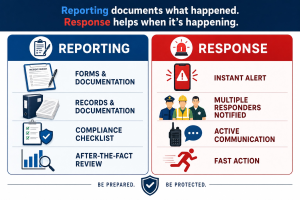
Incident reporting systems are usually designed for after-the-fact documentation.
They help organizations answer important questions such as:
- What happened?
- Who was involved?
- Where did the incident occur?
- What follow-up action is needed?
- How should the organization prevent this from happening again?
Those are valuable questions.
However, they are not the questions that matter most during the first few seconds of an emergency.
In the moment, employees need to know:
- How do I call for help immediately?
- Who is being notified right now?
- Has anyone seen the alert?
- Who is responding?
- What happens next?
According to the Occupational Safety and Health Administration, safety and health programs should take a proactive approach to identifying and controlling hazards before they lead to harm.
OSHA’s safety management guidance reinforces the importance of prevention, communication, and ongoing improvement.
But documentation does not replace immediate action.
Why Incident Reporting Systems Break Down During Emergencies
Incident reporting systems are useful when time allows.
Real emergencies do not always allow time.
That is the gap many organizations miss.
A reporting system may work well after an incident, but it may not help an employee who needs assistance right now.
Example Scenario
An employee encounters a threatening situation at work.
The person in front of them is angry, escalating, and unpredictable.
The employee may have several options:
- Fill out an incident report
- Send an email
- Call a supervisor
- Walk away and look for help
- Wait until the situation calms down
Each option has a problem.
None of them guarantee immediate visibility.
None of them alert multiple responders at the same time.
None of them create real-time coordination.
And in some situations, taking out a phone or stepping away to make a call may increase risk.
The Critical Gap: No Immediate Action Path
Incident reporting systems answer this question:
“What happened?”
Emergencies require a different question:
“What is happening right now, and who needs to respond?”
That difference is critical.
Reporting is about recordkeeping.
Response is about action.
When organizations rely only on reporting tools, they may create a dangerous delay between the moment an incident begins and the moment help is actually notified.
That delay can affect:
- Employee safety
- Response time
- Escalation risk
- Leadership awareness
- Post-incident recovery
The uncomfortable truth is this:
A well-documented incident is still a failed safety process if no one responded fast enough when it mattered.
Why Email, Forms, and Manual Escalation Are Too Slow
Many organizations still depend on manual communication during emergencies.
That may include emails, phone calls, text messages, radio calls, or verbal escalation.
These methods can work in normal situations.
But under stress, they become fragile.
An employee may freeze.
A supervisor may miss the call.
An email may sit unread.
A message may go to one person when several people need to know.
A team may not know whether someone else is already responding.
That creates confusion, duplication, and delay.
During an emergency, employees should not have to make several decisions before help is notified.
The process should be simple, fast, and clear.
How Real-Time Alert Systems Fill the Gap
This is where real-time alert systems become important.
Solutions like TeamAlert help organizations move from delayed reporting to immediate notification.
Instead of relying on one person to make a call, send an email, or complete a form, a real-time alert can notify the right people in seconds.
That changes the entire response process.
What Changes With Real-Time Alerts?
- Alerts happen immediately: Employees can trigger help quickly instead of navigating a slow reporting process.
- Multiple people are notified: Response does not depend on one person being available.
- Teams gain visibility: Leaders know an incident is active, not just documented later.
- Response becomes coordinated: The organization can act instead of guessing who knows what.
- Reporting still happens: Documentation can be completed after the situation is controlled.
The goal is not to replace incident reporting.
The goal is to put response first.
Response First, Reporting Second
Incident reporting still matters.
Organizations need records. Leaders need documentation. Safety teams need data. Compliance matters.
But sequence matters.
During an emergency, the order should be:
- Trigger the alert
- Notify the right people
- Begin response
- Contain the situation
- Document the details
- Review and improve the process
That order protects people first.
Then it protects the organization.
Too many workplaces reverse the order without realizing it. They build strong reporting systems, but weak response pathways.
That creates a false sense of preparedness.
The Risk of a Reporting-Only Safety Strategy
A reporting-only approach can make leadership feel informed while employees still feel unsupported.
That is a major blind spot.
If employees believe help will not arrive quickly, they may stop trusting the safety process.
They may hesitate to report concerns.
They may handle dangerous situations alone.
They may assume leadership only wants documentation after something goes wrong.
That is not a strong safety culture.
A strong safety culture gives employees a clear way to act when something is happening in real time.
What Organizations Should Look For
If your organization already has an incident reporting system, that is a good starting point.
But it should not be the only safety tool in place.
Ask these questions:
- Can employees call for help with one simple action?
- Are multiple responders notified at the same time?
- Can alerts be sent discreetly if needed?
- Does leadership know when an incident is active?
- Is there a clear process before, during, and after the event?
- Does documentation happen after response, not instead of response?
If the answer is no, the organization may have a reporting process but not a true emergency response process.
Final Thought: Reporting Does Not Replace Response
Incident reporting systems are important.
They help organizations learn, document, and improve.
But during a real emergency, action must come first.
The goal is not simply to record incidents.
The goal is to respond before the situation gets worse.
Because when seconds matter, a completed report is not enough.
People need help in the moment.
That is why organizations should pair incident reporting with real-time alerting, clear escalation paths, and immediate response coordination.
Response first. Reporting second. Safety always.
Frequently Asked Questions
What is the difference between incident reporting and emergency response?
Incident reporting documents what happened after an event. Emergency response focuses on what is happening right now and who needs to take action immediately.
Are incident reporting systems still necessary?
Yes. Incident reporting systems are important for documentation, compliance, review, and prevention. However, they should not be the only process employees rely on during emergencies.
Why do incident reporting systems fail during real emergencies?
They fail when they are used as a substitute for immediate response. Forms, emails, and manual escalation may be too slow when employees need help right away.
How can organizations improve emergency response?
Organizations can improve response by giving employees a fast way to trigger alerts, notify multiple responders, coordinate action, and document details after the situation is handled.
Ready to Strengthen Your Emergency Response Process?
If your organization has incident reporting in place but still lacks a fast way to alert the right people during an emergency, it may be time to close that gap.
Learn more about real-time alerting and workplace emergency communication at https://teamalert.com.


