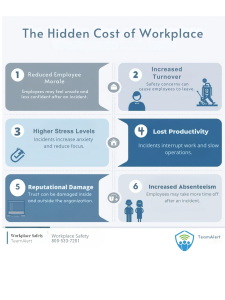
The trus cost of workplace incidents is often measured by immediate outcomes like injuries, liability, and compliance reporting. But the true cost of  workplace incidents goes much further than that. For many organizations, the biggest damage happens after the event—through reduced morale, lower productivity, increased absenteeism, higher turnover, and reputational harm.
According to OSHA’s safety management guidance, effective safety and health programs help organizations prevent injuries, reduce hardship, and take a proactive approach to workplace safety.
The Hidden Impact of Workplace Incidents
A workplace incident can interrupt operations in seconds, but its ripple effects can last much longer.
The hidden impact of workplace incidents may include:
- Reduced employee morale
- Higher stress across teams
- Increased absenteeism
- Lost productivity
- Increased turnover
- Reputational damage
When employees no longer feel safe or supported, performance often declines and recovery becomes harder.
How Workplace Incidents Affect Morale, Productivity, and Retention
Consider a common scenario.
An incident occurs in the workplace.
Immediately:
- Work is disrupted
- Employees feel unsafe
- Leadership shifts its attention to crisis management
Then the secondary effects begin:
- Team focus drops
- Stress increases
- Absenteeism rises
- Productivity declines
- Confidence in the workplace weakens
According to OSHA’s incident investigation guidance, workplace safety efforts that focus on identifying and correcting root causes can improve morale and increase productivity.
That means the cost of workplace incidents is not limited to the moment of the event. It often spreads across the organization afterward.
Why Response Time Directly Affects the Cost of Workplace Incidents
One of the biggest factors in determining the cost of workplace incidents is response time.
The longer an incident is allowed to escalate:
- The greater the disruption
- The more employees are affected
- The harder recovery becomes
- The higher the long-term organizational cost
Fast response does more than address the immediate problem. It helps contain operational, emotional, and financial impact before it spreads.
How Real-Time Workplace Safety Systems Minimize Impact
Organizations that use real-time workplace safety systems can often reduce the severity and reach of an incident.
Solutions like TeamAlert help organizations respond quickly when employees need help.
Benefits of faster workplace incident response can include:
- Faster intervention: reducing incident severity
- Limited exposure: containing the situation quickly
- Less disruption: helping teams return to normal sooner
- Improved recovery: restoring employee confidence faster
Contained Incident vs. Escalated Incident 
Imagine two similar workplace incidents.
In the first, the response is delayed.
- More employees are affected
- Operations are disrupted longer
- Recovery takes more time
- Total cost is significantly higher
In the second, the incident is contained quickly.
- Disruption is limited
- Fewer employees are affected
- Recovery is faster
- Long-term impact is lower
The difference is not always the incident itself.
The difference is how quickly the organization responds.
The Cost of Inaction Is Higher Than Prevention
Workplace safety systems are not only about protection in the moment.
They are also about reducing the long-term organizational cost of workplace incidents.
Because the real cost of an incident is not just what happens during the event.
It includes everything that happens after—lost trust, reduced performance, slower recovery, and avoidable disruption.
If your organization is evaluating ways to improve workplace safety and reduce incident-related disruption, TeamAlert can help you respond faster and protect your people more effectively.