Workplace Safety Systems: Choosing the Right One for Your Organization
When evaluating workplace safety systems, most organizations make the same costly mistake — they compare features and pricing while completely overlooking the one thing that matters most: how the system performs under real pressure. The right workplace safety systems directly impact employee well-being, emergency response speed, and your organization’s overall risk exposure. Getting this decision wrong doesn’t just waste budget — it puts people at risk.
Why Evaluating Workplace Safety Systems Matters More Than Ever
The market for workplace safety systems has expanded rapidly. With more options available, organizations often focus on a long feature list or the cheapest price point, while overlooking the most critical element: usability under pressure. The risk of this approach is selecting a system that looks great in a demo but fails completely during a real emergency. According to OSHA’s employee alarm standards, alarm systems must be perceived above ambient noise and light levels — a baseline that many systems still fail to meet.
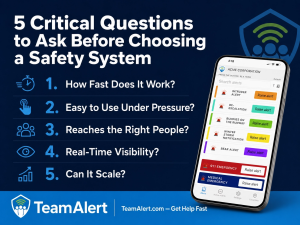
The 5 Critical Questions to Ask Before Buying Workplace Safety Systems
1. How Fast Do Workplace Safety Systems Deliver Alerts?
In emergencies, every second matters. Delays in communication can directly increase the severity of an incident. Solutions like TeamAlert are purpose-built to prioritize instant alert delivery, ensuring that critical information reaches the right people the moment a button is pressed. When evaluating workplace safety systems, always ask vendors for documented alert delivery times.
2. Are Workplace Safety Systems Easy to Use Under Pressure?
Imagine an employee who needs to trigger an alert during a crisis. Can they do it instantly with a single press? Or do they need to unlock a device, open an app, and navigate multiple confirmation screens? The fundamental principle of effective workplace safety systems is that simplicity equals speed. A system that requires complex steps under stress is a system that will fail when it matters most. The Department of Homeland Security recommends that alert notification systems be designed for immediate, intuitive activation.
3. Do Workplace Safety Systems Reach the Right People Immediately?
Effective workplace safety systems don’t just broadcast a message — they deliver targeted, simultaneous notifications to multiple designated responders. They eliminate single points of failure and ensure no alert is ever missed. Redundancy is not a luxury; it is a requirement for any system that claims to protect your people.
4. Do Workplace Safety Systems Provide Real-Time Visibility?
When an alert is triggered, responders need immediate context: what is happening, where it is happening, and who is involved. Workplace safety systems that provide real-time dashboards and location data enable a coordinated, rapid, and effective response — transforming a reactive situation into a managed one.
5. Can Workplace Safety Systems Scale With Your Organization?
The best workplace safety systems are not static tools. They grow with your team, adapt to new physical environments, and support multiple locations without requiring a complete overhaul. Before committing to any platform, ask specifically how it handles multi-site deployments and organizational growth. The American Society of Safety Professionals provides detailed guidance on scalability requirements for safety management systems.
Good vs. Great Workplace Safety Systems: A Real-World Comparison
A basic system sends alerts. That is it. It functions as a one-way megaphone with no coordination, no visibility, and no follow-through. An effective, great system — like TeamAlert — enables instant action, actively coordinates the response among all relevant team members in real-time, and ultimately improves outcomes. The difference between the two is not a matter of price. It is a matter of design philosophy.
The Bottom Line on Workplace Safety Systems
Workplace safety systems are not judged by their feature list during a sales pitch. They are judged by how they perform under extreme stress, in real situations, and when every second counts. Because in an emergency, the right system doesn’t just support safety — it defines it.
Ready to see what a great workplace safety system looks like in action? Visit TeamAlert.com and discover how your organization can get help fast with the push of a button.