Workplace violence prevention has been a major focus for years.
Many organizations now have training programs, workplace safety policies, reporting procedures, and de-escalation plans in place.
That is a good thing.
But it is not enough.
The uncomfortable truth is this: prevention alone cannot stop every incident.
Employees can be trained. Policies can be written. Warning signs can be documented. But when a situation escalates in real time, the question becomes much more urgent:
How fast can help arrive?
That is the gap many workplace violence prevention strategies miss.
The Gap Between Prevention and Reality
Most organizations focus heavily on prevention strategies such as:
- De-escalation training
- Incident reporting procedures
- Behavioral assessments
- Workplace safety policies
- Post-incident documentation
These tools matter. They help employees recognize warning signs, reduce risk, and respond more calmly under pressure.
According to the Occupational Safety and Health Administration, workplace violence includes acts or threats of physical violence, harassment, intimidation, and other threatening behavior that occurs at work.
Source: https://www.osha.gov/workplace-violence
OSHA also emphasizes that workplace violence can affect employees, clients, customers, and visitors.
That means organizations cannot afford to treat workplace violence prevention as a policy-only issue.
Why?
Because real-life incidents do not always follow the policy manual.
Why Prevention Strategies Break Down
Consider this scenario.
An employee recognizes early warning signs:
- A raised voice
- A tense posture
- Agitated behavior
- Escalating frustration
- Refusal to follow instructions
The employee uses their training. They remain calm. They try to de-escalate. They create space. They avoid confrontation.
But the situation continues to worsen.
At that point, the employee faces a serious problem.
Calling for help out loud may escalate the situation further. Leaving the area may not be possible. Reaching for a phone may be obvious. Waiting too long may increase the risk.
This is where many workplace violence prevention plans fall short.
They prepare employees for what to say.
But they do not always give employees a fast, discreet way to get help when talking is no longer enough.
Prevention Works Until It Doesn’t
Prevention is important.
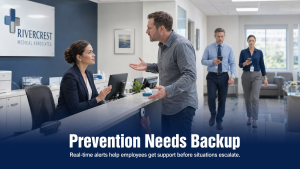
But prevention needs backup.
No employee can fully control:
- Unpredictable behavior
- Emotional escalation
- Sudden aggression
- Mental health crises
- Substance-related behavior
- Visitor, patient, client, or customer reactions
Training can reduce risk, but it cannot remove risk completely.
That is why real-time response tools are becoming a critical part of modern workplace violence prevention.
Systems like TeamAlert help employees request assistance quickly and discreetly when a situation begins to escalate.
Instead of relying only on the hope that an employee can manage the situation alone, organizations can give employees a direct path to support.
How Real-Time Alerts Strengthen Workplace Violence Prevention
Real-time alert systems do not replace training.
They reinforce it.
They give employees a way to act before a situation becomes more dangerous.
1. Silent Escalation
In some situations, asking for help out loud can make things worse.
A silent alert allows an employee to request assistance without drawing attention, interrupting the conversation, or increasing tension.
This is especially important in environments where employees interact with patients, clients, visitors, or members of the public.
2. Faster Response Times
The longer a situation escalates, the harder it may be to contain.
Real-time alerts reduce the delay between recognizing danger and notifying the right people.
That speed matters.
A faster response can help prevent confusion, reduce panic, and give employees support before the situation gets worse.
3. Team Awareness
Workplace violence prevention should never depend on one employee carrying the full burden alone.
When an alert is triggered, designated responders can be notified immediately.
This creates awareness across the team and allows help to move faster.
4. Earlier Intervention
The goal is not only to respond after something happens.
The goal is to intervene earlier.
When employees have a fast way to call for support, incidents can often be contained before they become more serious.
Use Case: From Escalation to Containment
Imagine a medical office.
A patient becomes verbally aggressive at the front desk. The staff member recognizes the warning signs and attempts to de-escalate.
At first, the employee speaks calmly and tries to redirect the conversation.
But the patient becomes louder, more agitated, and more confrontational.
The employee does not want to reach for the phone or shout for help because that may escalate the situation further.
Instead, the employee triggers a silent alert.
Within seconds:
- Nearby staff are notified
- Support begins moving toward the area
- Leadership becomes aware of the situation
- The employee is no longer handling the incident alone
The difference is not just technology.
The difference is timing.
Early warning signs are supported by real-time response, not just training.
Where Real-Time Alerts Make the Biggest Difference
Workplace violence prevention is especially important in environments where employees interact directly with the public or work in isolated areas.
Examples include:
- Medical offices
- Mental health clinics
- Local government offices
- Churches and ministry settings
- Schools and administrative offices
- Front desks and reception areas
- Social service organizations
- Customer service environments
In these settings, employees often face emotionally charged conversations.
They may be dealing with people who are frustrated, fearful, angry, confused, or under extreme stress.
That does not mean every difficult interaction will become violent.
But it does mean employees need a practical way to get help before things spiral.
Workplace Violence Prevention Should Include Response
A strong workplace violence prevention plan should answer three questions:
- How do we reduce the risk of violence?
- How do employees recognize early warning signs?
- How do employees get immediate help when a situation escalates?
Many organizations already answer the first two questions.
The third question is where the biggest gap often exists.
If an employee has to search for a phone, find a supervisor, leave the room, or hope someone overhears the situation, the response process may be too slow.
Real-time alert tools help close that gap.
Final Thought: Prevention Needs Reinforcement
Training prepares employees.
Policies guide employees.
Reporting systems document what happened.
But real-time alerts help protect employees when situations are happening.
That is the missing piece.
Workplace violence prevention should not depend on employees managing escalating situations alone.
Prevention matters.
But when prevention is not enough, immediate response can make all the difference.
Want to strengthen your workplace violence prevention plan with real-time alerts?
Learn more about TeamAlert here:
Start a free trial here:
https://manage.teamalert.com/signup/